Seeing the Unseen: How the Klein TI250 Turns Physics into Practical Insight
Update on Oct. 7, 2025, 8:38 a.m.
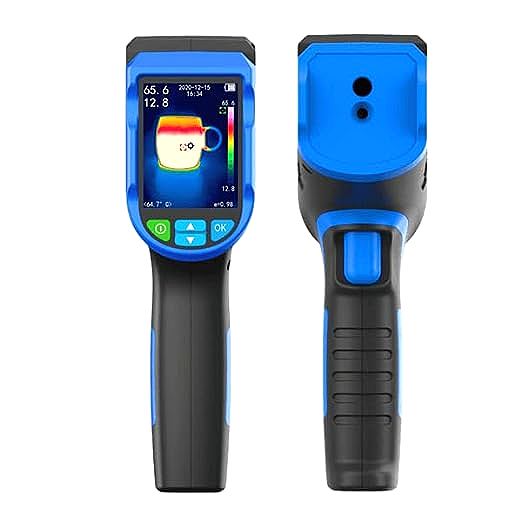
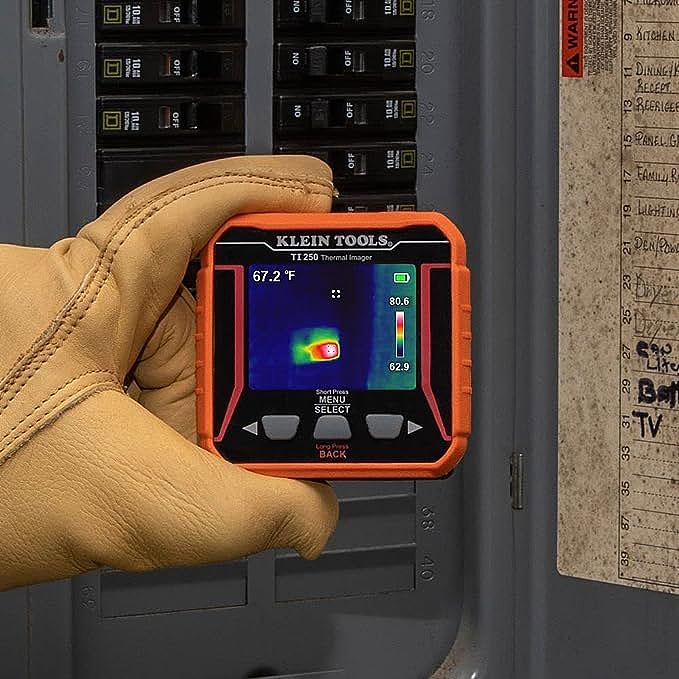
Place a cold can of soda on a wooden table. When you lift it a minute later, you see nothing but dry wood. But look at the same spot with a thermal imaging camera like the Klein Tools TI250, and you’ll see a ghostly blue circle—a cold echo of the can’s presence, slowly fading as the wood returns to ambient temperature. This isn’t magic; it’s a map. A map of data, painted with the invisible light of heat.
But how does a solid-state, handheld device capture something as intangible as temperature and convert it into a detailed, color-coded image? How can it “see” the warmth of a faulty wire through the opaque plastic of a wall plate? The answer is a fascinating journey that starts with a universal law of physics and ends with a clever piece of micro-engineering. Using the affordable and accessible Klein TI250 as our case study, let’s peel back the layers and explore how this remarkable technology translates the fundamental language of the universe—heat—into actionable human insight.
Layer 1: The Universal Glow and the Atmospheric Window
The first principle of thermal imaging is breathtakingly simple: everything in the universe with a temperature above absolute zero (-273.15°C or -459.67°F) is constantly glowing. This isn’t a metaphor. Your desk, the ice in your drink, your own body—they are all emitting electromagnetic radiation. We’re most familiar with this phenomenon when an object gets extremely hot, like a stovetop burner glowing a dull red and then a bright orange. That burner is emitting radiation in the visible light spectrum.
But at room temperature, objects are still glowing, just in a “color” our eyes are not equipped to see: infrared. This is the light of heat. The hotter an object is, the more infrared radiation it emits. A thermal camera is, at its core, a specialized digital camera whose sensor is tuned to see this specific part of the electromagnetic spectrum instead of visible light.
However, it can’t just see any infrared. The Earth’s atmosphere is surprisingly opaque to many infrared wavelengths, absorbing them before they can travel very far. Fortunately, there are “atmospheric windows,” specific wavelength ranges where infrared radiation passes through with little interference. The most important one for thermography is the Long-Wave Infrared (LWIR) window, from about 8 to 14 micrometers (μm). Devices like the TI250 are engineered to operate precisely within this window, ensuring they capture the heat signature of a distant object, not the heat of the air in between.
Layer 2: The Heart of the Machine - Inside the VOx Microbolometer
So, we know that every object is broadcasting its temperature in this special LWIR light. But how do you build an “eye” to see it? The answer is not film or a typical CMOS sensor like in your phone. The answer is a microbolometer—a marvel of micro-electro-mechanical systems (MEMS).
Inside the Klein TI250 is a Focal Plane Array (FPA) consisting of 10,800 of these microscopic sensors, arranged in a 120x90 grid. Each tiny pixel is made of a material called Vanadium Oxide (VOx), chosen for a very specific reason: its electrical resistance changes predictably and significantly with even the slightest change in temperature. The process works like this, thousands of times per second:
- Absorption: The grid of VOx pixels, each thermally isolated from its neighbors, absorbs the incoming infrared radiation from the scene.
- Heating: A pixel focused on a hot object absorbs more radiation and heats up a tiny fraction of a degree. A pixel focused on a cold object heats up less.
- Resistance Change: This minute temperature change causes a corresponding change in the VOx material’s electrical resistance.
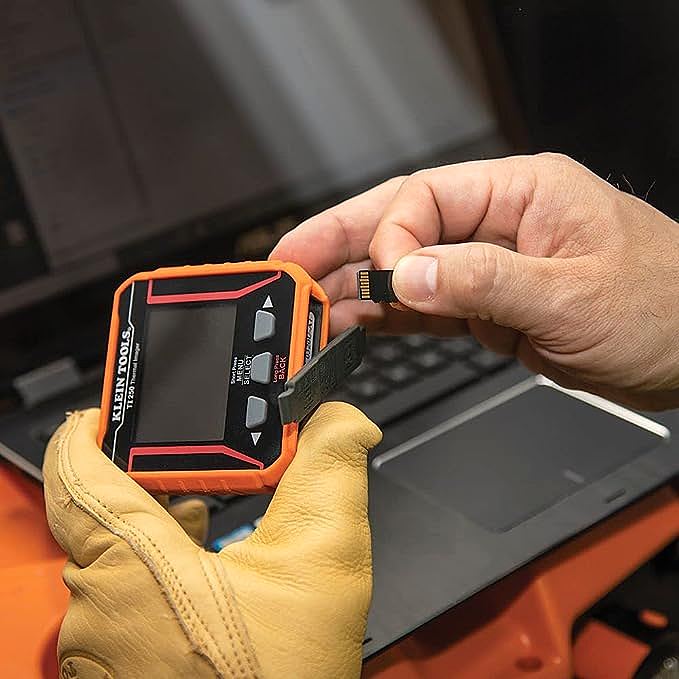
- Measurement: The camera’s sophisticated electronics then scan through all 10,800 pixels, measuring their individual resistance values and converting this massive grid of resistance data into a digital temperature map.
- Image Creation: This temperature map is then assigned a color or shade of gray based on the chosen palette (Ironbow, Rainbow, or Gray), creating the thermal image you see on the LCD screen.
And that distinct “click” you hear periodically? That’s the sound of a tiny shutter moving in front of the sensor for a fraction of a second. This gives the sensor a uniform temperature field to look at, allowing it to recalibrate each pixel’s baseline reading. This Non-Uniformity Correction (NUC) is critical for compensating for sensor drift and is the secret to the camera’s consistent accuracy.
Layer 3: Decoding the Numbers - What Specs Really Tell You
We’ve seen the 10,800 tiny sensors that act as the camera’s retina. But the quality of its vision is defined by a set of numbers on a spec sheet. Let’s translate these engineering terms into a language of capability.
Resolution (10,800 pixels / 120x90): Think of this as the number of thermal “nerve endings” in the camera’s eye. More pixels mean a sharper, more detailed image, and crucially, the ability to accurately measure the temperature of smaller objects from farther away. The 120x90 resolution of the TI250 is excellent for general diagnostics—finding an overheating motor or a drafty window—but it’s important to understand its limits when it comes to small targets.
Thermal Sensitivity (NETD < 60mK): NETD, or Noise Equivalent Temperature Difference, is arguably the most important specification for image quality. If resolution is how sharp your thermal vision is, NETD is how well you can see subtle gradients. Measured in milliKelvins (mK), it represents the smallest temperature difference the camera can detect. A value of <60mK, like in the TI250, means it can resolve temperature differences of less than 0.06°C. This is what allows it to see the faint thermal signature of moisture evaporating from a wall or the slight temperature change in a circuit board trace under load.
Frame Rate (9Hz): This number tells you how many times per second the camera updates the entire thermal map. A 9Hz rate means you get nine complete thermal images every second. This is why the image can feel slightly laggy during fast movements. While higher frame rates exist, devices above 9Hz are often subject to stricter international export controls, making 9Hz a common standard for accessible, consumer-facing thermal cameras. It’s more than adequate for the careful, deliberate scanning required for most inspection work.
Layer 4: The Art of Accuracy - The Physics of Emissivity
There’s one final, crucial layer to understand. The microbolometer measures incoming radiation, not temperature directly. To convert that radiation measurement into an accurate temperature, the camera must be told about the nature of the surface it’s looking at. This is the concept of emissivity.
The physics is governed by the Stefan-Boltzmann law, which states that the energy radiated by an object is proportional to its emissivity and its temperature. Emissivity is a value from 0 to 1 that describes how efficiently a surface radiates heat. Imagine two identical teapots, both filled with 90°C water. One is made of polished, shiny silver (emissivity ≈ 0.02), and the other is coated in matte black paint (emissivity ≈ 0.97). If you point the TI250 at them, the black teapot will appear brilliantly hot, and its temperature reading will be accurate. The silver teapot will appear cool and will reflect the thermal signature of everything around it, giving a completely false reading.
They are the same temperature, but they “glow” with vastly different intensities in the infrared spectrum. This is why the TI250 allows you to adjust the emissivity setting. To get an accurate reading, you must match the setting to the surface you’re measuring.
| Material | Typical Emissivity |
|---|---|
| Concrete, rough | 0.97 |
| Wood, unpainted | 0.90 |
| Human Skin | 0.98 |
| Water | 0.96 |
| Electrical Tape, Black | 0.95 |
| Copper, polished | 0.04 |
| Aluminum, polished | 0.05 |
Conclusion: From Abstract Physics to Actionable Insight
From the universal glow of every object in existence, filtered through our planet’s atmospheric window, focused onto a microscopic grid of heat-sensitive vanadium oxide, and finally interpreted through the lens of emissivity—the journey of a heat photon to a pixel on the TI250’s screen is a triumph of applied physics.
Understanding this journey does more than satisfy curiosity. It fundamentally changes how you use the tool. You no longer just see a hot spot; you see a confirmation of the laws of thermodynamics. You no longer get frustrated by a “click” or an odd reading from a shiny surface; you understand the calibration process and the physics of radiation. The Klein TI250, and thermal imagers like it, are more than just powerful diagnostic tools. They are accessible windows into the unseen, vibrant, and data-rich thermal world that is all around us, empowering not just our hands, but our minds.