Unlocking the Invisible: A Practical Guide to Thermal Imaging
Update on Oct. 6, 2025, 4:34 p.m.
Hold your hand a few inches away from a fresh cup of coffee. You feel its warmth, a silent broadcast of energy across the space between. Our bodies are primitive thermal detectors, but this sense is vague and limited. What if you could see that warmth? What if you could see the lingering heat from a footprint on the carpet, the cold draft seeping under a door, or the overloaded circuit breaker glowing with unseen danger? This invisible world of heat, or infrared radiation, is constantly telling a story about the objects around us—their condition, their efficiency, their potential failures. The world has a hidden language, and it is spoken in heat.
Thermal imaging cameras are our translators. They capture this infrared energy and convert it into a picture our eyes can understand. For years, this technology was the exclusive domain of scientists and high-budget industrial teams. Today, powerful yet compact tools like the FLIR C3-X are making this incredible capability accessible to homeowners, tech enthusiasts, and professionals alike. But with accessibility comes misunderstanding. This guide aims to demystify thermal imaging by busting the most common myths, revealing what this technology can truly do, and using the C3-X as our practical lens to explore this fascinating, unseen world.
Myth #1: “Thermal Cameras Can See Through Walls.”
This is the most pervasive myth, fueled by spy movies and science fiction. The truth is, thermal cameras have no X-ray vision. They cannot see through solid objects like walls, doors, or even a simple pane of glass (which is why you can’t use one to see the temperature of things outside your window). What thermal cameras do is detect the surface temperature of objects with incredible precision.
So why are they so useful for finding problems behind walls? Because they can see the effects that hidden issues have on the surface. Think of the wall as a canvas. A water leak inside the wall will slowly soak the drywall; as this moisture evaporates, it causes a distinct cooling effect on the surface. A thermal camera will see this as a cold, often irregularly shaped patch, revealing the leak’s presence long before a water stain appears. Similarly, a section of wall missing insulation will be a poorer barrier to the outside temperature. In winter, this will show up as a cold vertical stripe on the interior wall. The camera isn’t seeing the missing insulation itself; it’s seeing the resulting cold spot on the wall’s surface. To do this effectively requires a high degree of thermal sensitivity. A tool like the FLIR C3-X, with its ability to detect temperature differences as small as 0.07°C, is perfectly tuned to pick up on these subtle clues that our hands—and eyes—would completely miss. It gives you the power to read the story the wall is telling.
Myth #2: “Resolution is the Only Thing That Matters.”
After learning that thermal cameras see surfaces, it’s natural to assume that the camera with the most pixels—the highest resolution—is always the best. While resolution is important, a blurry, high-resolution image can be far less useful than a clear, lower-resolution one that provides context. The challenge with raw thermal images is that they lack the familiar visual details that help our brains identify objects. A hot spot is just a bright blob until you know what is hot.
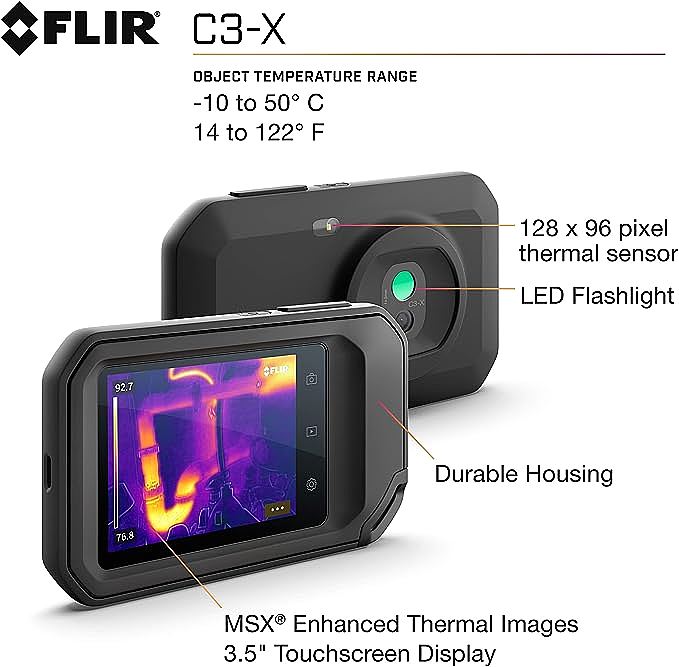
This is where clever image processing, like FLIR’s MSX technology, becomes a game-changer. Think of it like a high-tech coloring book. The camera’s thermal sensor acts like the artist, applying the “colors” (the heat data) to the scene. Simultaneously, a built-in 5-megapixel standard digital camera acts as the illustrator, sketching the sharp, defining “lines” of the objects in view. MSX technology then intelligently fuses these two images, embossing the visual lines over the thermal colors. The result is a single, hybrid image that is instantly understandable. An indistinct warm area on a motor becomes a clear picture of an overheating bearing. A fuzzy cold patch on the ceiling is now clearly defined around the edges of a light fixture. On a device like the C3-X, this means its 128x96 pixel thermal image is dramatically enhanced, providing a level of detail and clarity that punches far above its weight class in raw resolution. It proves that the “best” image is the one that provides the most actionable information, not just the most pixels.
Myth #3: “They Just Show ‘Hot’ and ‘Cold’.”
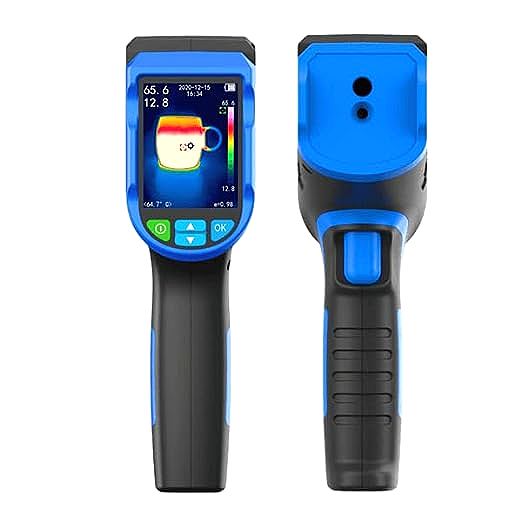
At first glance, a thermal image with its vibrant reds and cool blues seems to be a simple map of hot and cold. This is another oversimplification. In reality, a modern thermal camera is a sophisticated measurement instrument, a radiometer that captures thousands of individual temperature points in a single shot. The colors are just a visual aid, a “palette” chosen to make the data easy for us to interpret.
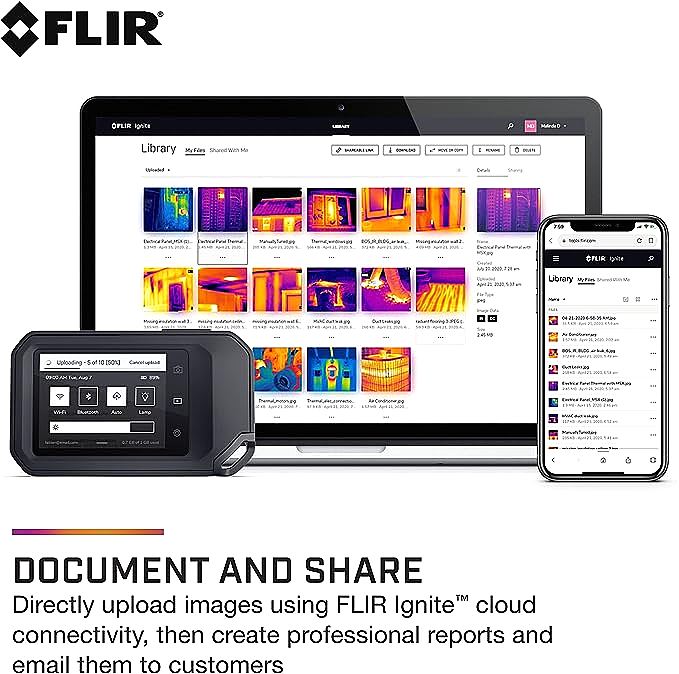
When a camera like the C3-X captures an image, it saves it as a radiometric JPEG. This isn’t a normal picture file. Embedded within it is the original temperature data for every single one of its 12,288 pixels. You can open this file later in software like FLIR Thermal Studio, point your cursor anywhere on the image, and see the precise temperature that was recorded at that spot. The camera itself has a wide measurement range, from a frigid -20°C (-4°F) to a scorching 300°C (572°F), making it suitable for everything from checking a freezer to inspecting an oven. The on-screen spot meter allows you to get live temperature readings in the field. For accurate measurements, especially on shiny or reflective surfaces, professionals even adjust a setting called “emissivity.” This understanding transforms the camera from a device that takes colorful pictures into a powerful, non-contact thermometer that can measure anything you can see.
From Image to Insight: What Can You Truly Discover?
Once you move past the myths and understand the true capabilities of thermal imaging, a new world of diagnostic possibilities opens up. With a tool like the FLIR C3-X in hand, you become a detective, capable of uncovering problems that were previously invisible.
-
Become an Energy Detective: Your home is constantly leaking expensive heated or cooled air. A quick scan with a thermal camera can instantly reveal poorly sealed windows, uninsulated attic hatches, and gaps in your wall insulation. Finding and fixing these leaks can lead to real savings on your energy bills.
-
Become a Moisture Hunter: Water is a home’s worst enemy. A thermal camera can be your best friend in finding it. Scan under sinks, around toilets, and on ceilings below bathrooms to find the subtle cold spots that indicate a hidden leak, allowing you to fix it before it leads to costly mold and rot.
-
Become an Electrical Sentinel: Faulty electrical connections, overloaded circuits, and failing components all generate excess heat before they fail catastrophically. A routine scan of your electrical panel can reveal a dangerously hot breaker that is invisible to the naked eye, providing an early warning that could prevent a fire.
-
Become a Mechanical Analyst: From the squeaky wheel on your garage door to the engine in your car, friction and malfunction create heat. Thermal imaging can help you pinpoint overheating bearings, slipping belts, or blocked radiator fins, turning you into a proactive maintenance expert.
Conclusion: Gaining a New Way of Seeing
Thermal imaging is not magic; it is simply science made accessible. It does not grant you superpowers, but it does give you a powerful new sense. It allows you to perceive the world in a way you never have before, translating the constant, invisible flow of heat energy into clear, actionable insights. Tools like the FLIR C3-X, by combining sophisticated imaging technology with a rugged, user-friendly design, have placed this capability within our reach. They empower us to be more efficient professionals, more knowledgeable homeowners, and more curious explorers of the physical world. The ultimate reward is not just in finding problems, but in gaining a fundamentally deeper understanding of the hidden forces that shape the world around us.