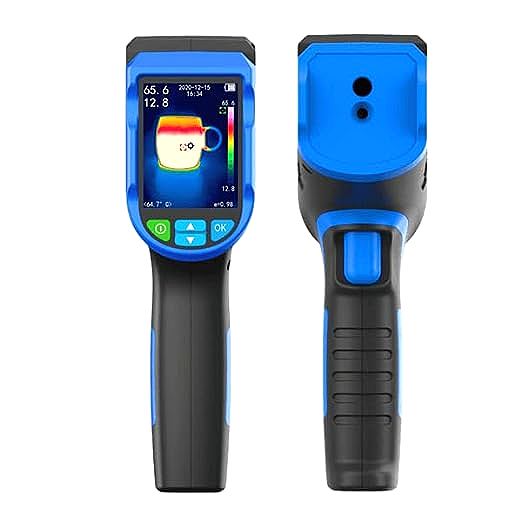
A Reality Check: What the World Looks Like Through a $70 Thermal Camera
Update on Oct. 7, 2025, 8:28 a.m.
You’ve read the theory. You understand that the tiny 32x24 sensor in a sub-$100 thermal imager is the David to the display screen’s Goliath. But the question that truly matters remains: what happens when you actually point this 768-pixel eye at the real world? What can you really see?
Forget the spec sheets and the technical jargon for a moment. Let’s embark on a practical journey. We’ll take this budget thermal camera through a series of common missions—tasks that hopeful buyers dream of accomplishing. For each scenario, we will contrast the exciting dream with the often-sobering reality, providing an honest exploration of what your money actually buys you in the world of thermal vision.

Scenario 1: The Hunt for the Energy Vampire (Drafts & Insulation Gaps)
The Dream: You become an energy-efficiency hero overnight. With your new thermal vision, you gracefully scan the windows and doors of your home. On the screen, you see crisp, dark-blue tendrils of cold air sneaking in around a window seal, a clear and precise map showing you exactly where to apply weatherstripping. You find a missing patch of insulation in the attic, visualized as a perfect, cold rectangle against the warmer ceiling.
The Reality (with 32x24 Resolution): You point the camera at the window. You see… a blob. The entire window pane area appears as a slightly cooler, bluish rectangle compared to the warmer wall. Near the bottom, the blue seems a little deeper, a little more intense. Is that the draft? Or is it just the thermal signature of the aluminum frame, which is naturally more conductive than the wall? You can’t tell. You’ve confirmed that the window area is a “cold zone,” but you have zero precision to guide your repairs. It’s the thermal equivalent of a doctor telling you the pain is “somewhere in your abdomen.” It’s a starting point for guessing, not a diagnosis.

Scenario 2: The Plumber’s Nightmare (Detecting Water Leaks)
The Dream: You notice a faint musty smell and suspect a small leak. You scan the ceiling under the upstairs bathroom and spot a subtle, cool, and well-defined shape on the drywall, pinpointing the exact location of a slow drip long before it causes catastrophic damage.
The Reality (with 32x24 Resolution): The sensor can only detect significant temperature differences. For a small, emerging leak, the cooling effect on the drywall is often less than a degree or two. A 768-pixel sensor with a likely high NETD (thermal sensitivity) will miss this entirely; it gets lost in the noise. However, if the leak has been going on for weeks and has thoroughly soaked a two-foot-wide area of ceiling, then yes, you will see a large, obvious cold blotch. The problem is, by that point, you probably don’t need a thermal camera to know you have a major issue. This tool can only detect a flood, not help you prevent one.

Scenario 3: The Electronics Hobbyist’s Helper (PCB Hot Spot Analysis)
The Dream: You power up your latest custom circuit board. You hover the thermal camera over it and instantly see that one tiny voltage regulator, measuring just a few millimeters across, is glowing bright yellow, indicating it’s overheating and on the verge of failure.
The Reality (with 32x24 Resolution): You point the camera at your 4x4 inch circuit board. The entire board is represented on your screen by a grid of maybe 5x5 colored squares. You can see that one quadrant of the board is generally warmer than the rest, but identifying an individual component is physically impossible. Each pixel from the sensor is covering a large area of the board containing dozens of components. It’s like trying to read a newspaper from a hundred feet away. You know there’s text, but you can’t make out a single word.
Scenario 4: The Backyard Safari (Finding Pets or Wildlife at Night)
The Dream: Your cat has been missing for an hour after dusk. You scan the dark backyard, and against the cool backdrop of the grass and trees, you see the perfectly clear, warm outline of your feline friend hiding in the bushes.
The Reality (with 32x24 Resolution): You scan the yard and suddenly, a single, bright, orange pixel appears on the screen. A moment later, it moves. You have successfully detected a “warm thing over there.” Is it your cat? A raccoon? A neighbor’s small dog? You have no idea. The 768-pixel image provides no shape or detail for identification. It works as a very basic thermal motion detector, confirming the presence of life. But to know what that life is, you’ll still need to grab a flashlight.

The Common Thread: Signal vs. Noise, Blob vs. Detail
A pattern is clear. In every scenario, the sub-$100 thermal imager is a “blob detector.” It is capable of confirming the existence of a significant thermal event—a large cold zone, a major leak, a generally hot area, a living creature. It excels at telling you that something is happening.
Where it universally fails is in providing detailed, actionable information. It cannot distinguish between a drafty seal and a conductive frame. It cannot find a small leak. It cannot isolate a single component. It cannot identify an animal. It gives you a signal, but it cannot resolve the fine details from the surrounding thermal noise.
Conclusion: A Tool for Discovery, Not Diagnosis
So, is a $70 thermal camera a worthless toy? Not entirely, but its role must be radically redefined. It is not, by any stretch of the imagination, a diagnostic tool. You cannot use it to reliably diagnose and pinpoint specific problems for repair. For that, you need a camera with a higher resolution sensor (at least 80x60, and ideally 160x120 or more), which is a significant step up in price.
Instead, a sub-$100 imager should be viewed as an affordable discovery tool. Its greatest strength is making you aware of the invisible world of heat. It can be the first step on a troubleshooting journey. It can show you that a wall is generally cold, prompting you to investigate further with better tools. It can confirm a catastrophic failure. Most importantly, it can spark your curiosity and teach you to think in terms of temperature.
It is the flashlight in a dark room that shows you where the furniture is, but not the keyhole you need to find. It’s the first step on a journey, not the final destination. And for $70, simply being able to take that first step can be a valuable discovery in itself.