The Micro-Climate Architect: Why You Need DWEPTU RXZ885 Sensors in Your Humidors, Dry Boxes, and Terrariums
Update on Nov. 28, 2025, 10:28 a.m.
In the age of smart homes, we are obsessed with “room temperature.” But for hobbyists and preservationists, the room average is a useless metric. The humidity inside your filament dry box, the micro-climate of your cigar humidor, or the basking spot in your gecko’s terrarium can be vastly different from the air three feet away.
The DWEPTU RXZ885 Mini Digital Thermometer is not a smart device. It doesn’t have Wi-Fi, an app, or a history graph. And that is exactly why it is brilliant.
Priced at a few dollars per unit, it allows you to deploy a Distributed Sensor Network across dozens of critical micro-environments without breaking the bank. This article analyzes why quantity often trumps connectivity when managing the delicate physics of moisture and heat in small spaces.
The Physics of the “Micro-Climate”
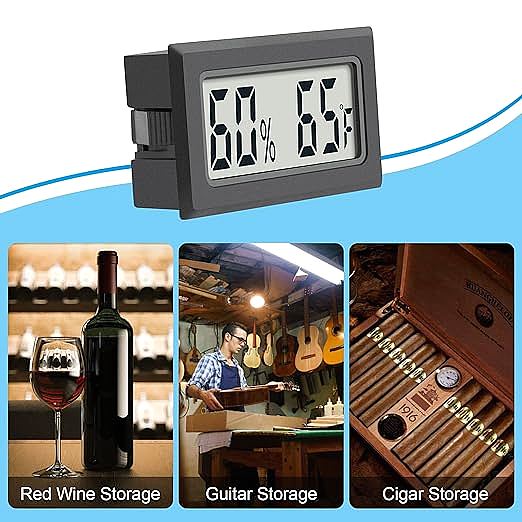
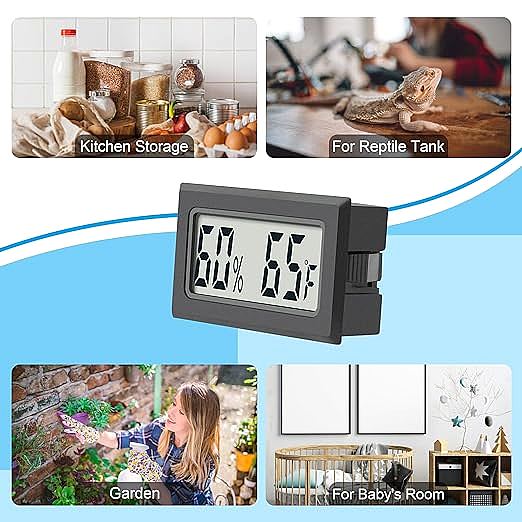
A micro-climate is a local atmospheric zone where the climate differs from the surrounding area. In your home, these are everywhere. * The 3D Print Lab: PLA filament degrades at >40% humidity. Your room might be 50%, but inside a sealed box with desiccant, it needs to be <20%. The DWEPTU allows you to verify that your silica gel hasn’t saturated. * The Humidor: Cigars require a precise 65-70% RH. A fluctuation of 5% can ruin the burn or invite mold. A dedicated sensor inside the box is non-negotiable. * The Terrarium: Reptiles thermoregulate by moving between hot and cold zones. You need sensors in both zones, not just one on the wall.
The DWEPTU RXZ885 utilizes a Capacitive Humidity Sensor, which measures moisture by detecting changes in the dielectric constant of a polymer film. While not lab-grade, this technology is incredibly responsive to relative changes, making it perfect for spotting a failed seal or a spent desiccant pack.
Volume vs. Precision: The Economic Case
Why buy a 2-pack or multipack of simple sensors instead of one $50 smart sensor? Granularity.
If you have 20 spools of filament or 5 reptile tanks, buying 20 smart sensors is cost-prohibitive ($1000+). Buying 20 DWEPTU units costs less than one high-end device. * The Strategy: Use one high-precision reference device to calibrate your “fleet” of DWEPTU sensors. Mark the offset (e.g., “+2%”) on the back of each unit. Now you have a calibrated network for pennies on the dollar.
The Battery Reality: LR44 Physics
The RXZ885 runs on two LR44 alkaline button cells. These batteries provide a stable 1.5V output but have a steep drop-off at the end of their life. * Maintenance Tip: As the battery voltage drops, the LCD contrast fades and sensor accuracy can drift. If the display looks dim, don’t trust the reading—change the batteries. With a typical lifespan of 6-8 months, keeping a strip of spare LR44s is part of the ownership protocol.
Design for Integration
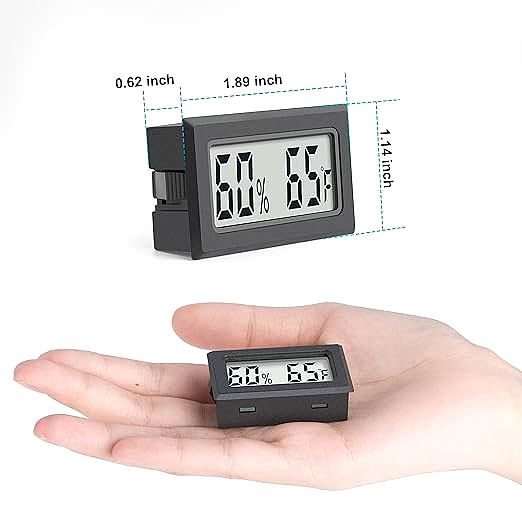
The form factor of the RXZ885 is its secret weapon. At just 1.89 x 1.14 inches, it fits where others can’t. * Embedded Mounting: The housing is designed with a lip, allowing it to be snap-fitted into a rectangular cutout. This makes it a favorite for DIYers building custom dry boxes or modifying humidor lids. * Minimal Intrusion: Inside a curing jar or a small Tupperware container, it displaces minimal volume, leaving more room for your product.
Conclusion: The Essential Monitor
The DWEPTU RXZ885 is the “post-it note” of the sensor world: cheap, ubiquitous, and incredibly useful when you need to label the status of a specific object.
It doesn’t replace your smart home thermostat; it complements it. It goes into the dark, sealed corners where your expensive gear lives—your camera lens case, your filament dryer, your cigar box—and acts as a silent sentry against the invisible enemies of moisture and heat.