Control in Chaos: The Case for Physical Buttons and Acoustic Transparency in Sports Audio
Update on Jan. 14, 2026, 9:35 a.m.
High-intensity interval training (HIIT). Trail running in the rain. Powerlifting with chalk-covered hands. These are environments of controlled chaos. In these moments, the athlete’s cognitive load is high, focused entirely on breathing, form, and the terrain. The last thing they need is to fight with their equipment.
Yet, a trend in modern consumer audio has moved towards sleek, capacitive touch controls—invisible surfaces that require a precise tap or swipe. While elegant in a coffee shop, these controls often fail spectacularly in the gym. Sweat conducts electricity, triggering phantom touches. Numb fingers miss the touch zone. The lack of tactile feedback leaves the user guessing.
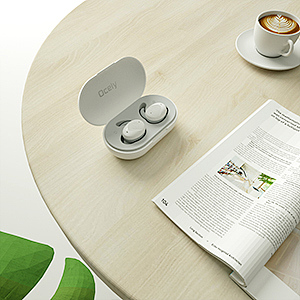
The OCELY Lilt Wireless Sports Earbuds buck this trend by retaining Physical Buttons. This design choice, along with their Transparency Mode, highlights a philosophy of “Control in Chaos.” This article explores the Human-Computer Interaction (HCI) challenges of sports audio and why tactile feedback and situational awareness are critical safety features for the active user.
The Haptics of Reliability: Why Buttons Matter
In the field of User Experience (UX) design, Haptic Feedback—the sense of touch—is a crucial confirmation channel. When you press a physical button, the “click” tells your brain that the command has been registered. You don’t need to wait for a beep or check your phone.
The Sweat Factor
Capacitive touch sensors work by detecting the electrical changes caused by the water in your fingertip. Unfortunately, a drop of sweat rolling down the earbud can mimic this electrical signature, causing music to pause or skip randomly. Conversely, a calloused, chalky finger might not register at all.
The OCELY Lilt’s physical buttons operate on a mechanical switch mechanism. They are immune to sweat, rain, and gloves. Whether you are mid-sprint or wearing winter running gear, a mechanical press is unambiguous. It provides Functional Certainty. This reliability allows the athlete to maintain their “Flow State”—that zone of deep immersion in the activity—without being jarred out of it by technical glitches.
While some users note that physical buttons can push the earbud deeper into the ear canal, this is a trade-off for reliability. A well-designed button, placed correctly (often on the top edge or requiring a pinch gesture), minimizes this discomfort.
Acoustic Transparency: The Safety of Hearing
Isolation is great for focus, but dangerous for survival. For the urban runner or the cyclist, blocking out the world completely removes a vital sensory input: sound. The sound of an approaching hybrid car, a bicycle bell, or a shout can be the difference between a workout and an accident.
The Algorithm of Awareness
The OCELY Lilt features Transparency Mode (or Hear-Through). This technology uses the external microphones—usually reserved for phone calls—to pick up ambient sound. The Digital Signal Processor (DSP) then inverts the usual noise-cancellation logic. Instead of suppressing these sounds, it amplifies them and mixes them into the audio feed.
This creates an Augmented Reality (AR) for your ears. You hear your music, but you also hear the world. The challenge for engineers is latency and naturalness. If the processing is too slow, the external sound arrives with an echo. If the EQ is off, wind noise can become deafening. The Lilt’s ability to toggle this mode instantly (often via a long press of that reliable physical button) allows the user to switch between “Immersion” (Passive Noise Cancellation) and “Awareness” (Transparency) in seconds.
This feature is not just a convenience; it is a Safety System. It allows the athlete to maintain Situational Awareness without stopping their music or removing their gear.
The Psychology of the Beat: Audio as a Performance Enhancer
Underlying all this technology is the reason we wear sports earbuds in the first place: Music improves performance. This is a scientifically proven phenomenon known as Ergogenic Effect.
BPM and Effort
Studies have shown that music with a high Beats Per Minute (BPM) can increase an athlete’s output and endurance. The rhythm acts as a metronome, regulating cadence in running or cycling. More importantly, music dissociates the mind from the sensation of fatigue. It distracts the brain from the signals of pain and exhaustion coming from the muscles.
To achieve this, the audio must be uninterrupted. A connection dropout or a battery failure breaks the spell. The OCELY Lilt’s Bluetooth 5.2 chip ensures a stable connection even in environments crowded with RF interference (like a busy gym). And the 24-hour total battery life ensures that the device is always ready. The “15-minute quick charge for 2 hours of play” is specifically designed for the forgetful athlete who needs a quick boost before heading out.
Conclusion: The Tool for the Trade
The OCELY Lilt is designed with a specific user persona in mind: the person who views their workout not as a leisure activity, but as a discipline. For this user, gear must be invisible in its reliability.
By choosing physical buttons over touch sensors, and prioritizing stable fit and acoustic transparency over gimmicks, the Lilt positions itself as a tool for the trade. It understands that in the heat of exertion, the most advanced feature is often the one that simply works, every single time.