The Anatomy of Isolation: Ergonomics and the Transition from Stage to Street
Update on Jan. 14, 2026, 9:34 a.m.
In the raucous environment of a live concert, the musician faces a paradox: to perform perfectly, they must hear themselves clearly, yet they are standing in one of the loudest places on Earth. The solution to this problem was the invention of the In-Ear Monitor (IEM). Unlike headphones that sit on the head, IEMs are designed to plug the ear canal, creating a physical barrier against the outside world.
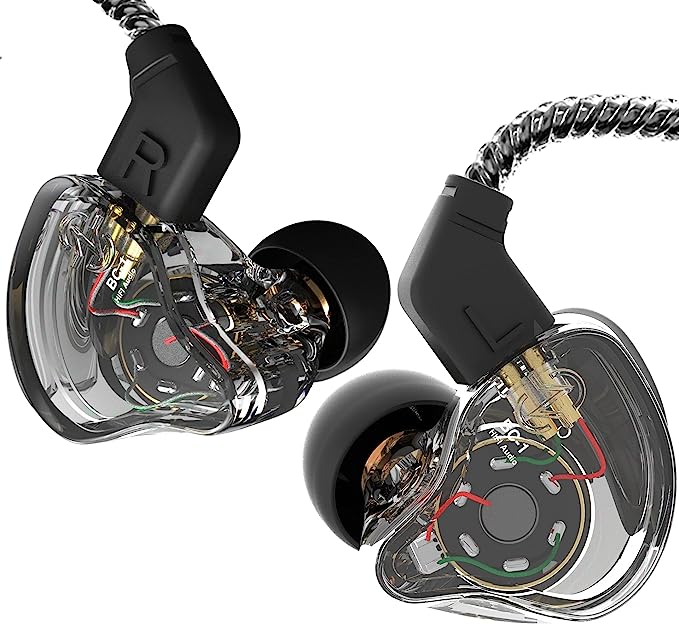
Originally custom-molded for rock stars, this technology has migrated from the stage to the street. Commuters, gamers, and office workers are discovering that the same isolation used by drummers to block out cymbal crashes is perfect for blocking out subway screeching. The YINYOO CCZ Melody represents this transition—a universal-fit IEM that brings professional-grade ergonomics to the everyday user.
This article explores the Science of Passive Isolation, the crucial role of Ergonomics in sound quality, and how IEMs serve as a protective shield for our hearing in a noisy world.
The Physics of the Seal: Passive Noise Isolation
When we talk about “noise cancelling,” most people think of Active Noise Cancellation (ANC)—complex electronics that generate anti-noise. However, IEMs like the CCZ Melody rely on Passive Noise Isolation (PNI). This is a simpler, yet often more effective, principle based on physical sealing.
The Ear Canal as a Chamber
The human ear canal is a resonant chamber. For an IEM to work, it must create an airtight seal with the canal walls. This seal performs two critical functions:
1. Blocking External Noise: A good seal can reduce ambient noise by 20-30 dB. This is significant. It turns a shouting match into a whisper. Unlike ANC, which struggles with sudden, sharp sounds (like a voice or a clatter), PNI blocks sound across the entire frequency spectrum simply by being a physical barrier.
2. Trapping Bass Pressure: Low-frequency sounds (bass) rely on pressurizing air. If the seal is broken (a “leaky” fit), the pressurized air escapes, and the bass vanishes. This is why a loose earbud sounds tinny.
The CCZ Melody facilitates this seal with its PC Cavity design and multiple sizes of TPE (Thermoplastic Elastomer) eartips. TPE is a material chosen for its ability to deform slightly with body heat, molding to the irregularities of the ear canal to maintain that crucial airtight lock.
Stability Engineering: The Role of the Ear Fin
A seal is useless if it breaks the moment you move. The human jaw is connected to the ear canal; simply talking or chewing can shift an earbud out of place. Professional custom IEMs solve this by filling the entire outer ear (concha). Universal IEMs must be smarter.
The CCZ Melody introduces a patented TPE Ear Fin (or wing). This is a small, soft projection on the back of the shell. * The Anchor Point: The fin tucks into the cymba conchae (the upper fold of the ear). * The Suspension System: By anchoring at the top and the bottom (the ear tip), the IEM is suspended securely.
This triangulation ensures that the earpiece resists the gravitational pull of the cable and the mechanical movement of the jaw. For musicians, this means the monitor stays in during a high-energy performance. For the casual user, it means the earbuds don’t fall out during a jog or a commute. The “wrap-around” cable design further aids this by routing the wire behind the ear, transferring the cable’s weight to the top of the ear rather than dragging on the ear canal itself.
From Monitoring to Enjoyment: The “IEM Sound”
Why do gamers and audiophiles prefer IEMs over standard earbuds? It comes down to Presentation. Because IEMs sit closer to the eardrum and block outside noise, they offer a level of detail retrieval that open-back headphones struggle to match in noisy environments.
The “Microscope” Effect
IEMs act like an audio microscope. In gaming, this translates to “positional audio”—hearing exactly where footsteps are coming from. In music, it reveals the texture of a guitar string or the breath of a singer. The CCZ Melody’s hybrid drivers utilize this isolated environment to project a highly detailed soundstage directly into the listener’s brain.
This intimacy is what defines the “Monitoring” experience. It is less about “background music” and more about “active listening.”
Audio Hygiene: The Protector of Hearing
Perhaps the most underrated benefit of the IEM form factor is Hearing Preservation. In a noisy environment (like a bus or plane), users of standard earbuds (like AirPods) tend to turn the volume up to drown out the noise. This “masking” often pushes the volume to dangerous levels (above 85 dB), causing cumulative hearing damage over time.
Because the CCZ Melody provides significant passive isolation, the “noise floor” is lowered. You can listen to your music at much lower volumes and still hear every detail clearly. You aren’t fighting the environment; you have removed it. By allowing listeners to enjoy music at safe volumes, IEMs serve as a critical tool for long-term auditory health.
Conclusion: The Personal Soundstage
The YINYOO CCZ Melody is more than a budget headphone; it is an entry point into a different way of listening. It brings the functional design of professional stage gear—secure fit, isolation, and over-ear routing—to the daily routine.
In doing so, it grants the user a power that was once the domain of performers: the ability to step out of the chaos of the environment and into a private, controlled, and high-fidelity soundstage, anywhere, anytime.